

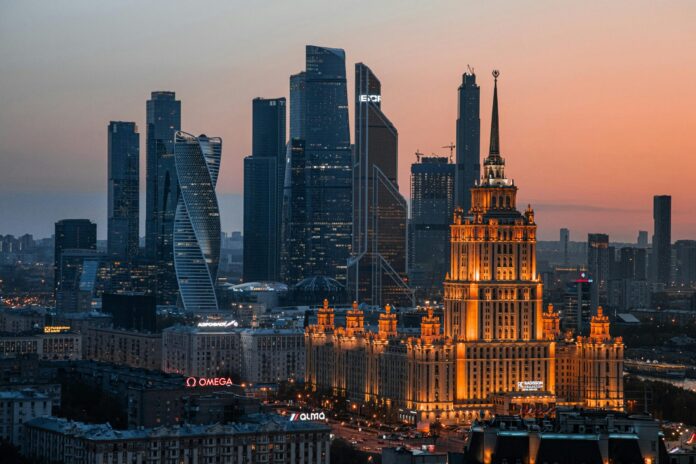

Moscow is reaching for the sky. Once confined to the iconic towers of Moscow-City, high-rise construction has spread across the capital, with one in three new residential developments now exceeding 30 storeys. As modern engineering meets urban ambition, the Russian capital is transforming into a vertical metropolis.
The Moscow International Business Center (MIBC), commonly known as Moscow-City, is an under-construction commercial development occupying 60 hectares on the Presnenskaya Embankment of the Moskva River, approximately 4km west of Red Square. The Moscow Government first conceived the project in 1992 as a mixed-use development of office, residential, retail and entertainment facilities.
The complex is home to the highest number of skyscrapers in Europe. Moscow has six ‘supertall’ skyscrapers above 300m in height, tying it with several other cities for the ninth most supertall skyscrapers in the world. From 2007 to 2017, skyscrapers in the MIBC continuously succeeded each other as the tallest building in Europe.
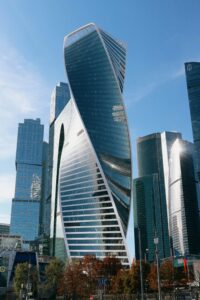
The tallest structure in the complex is the East Federation Tower, at just under 374m, which is the tallest building in Moscow and the second-tallest building in Europe after the Lakhta Centre in St. Petersburg. Other notable towers include the OKO complex, with its South Tower reaching 354m, the Mercury City Tower at 339m with its distinctive copper-coloured glazing, and the Evolution Tower, recognised for its unique spiral design.
By 2016, 12 of the 23 planned facilities were already built, seven buildings were under construction, and four were in the design stage. An estimated 250,000 to 300,000 people work, live in or visit the complex at any given time. The area combines business offices, residential apartments, restaurants, shopping centres including the six-storey Afimall City, observation decks and entertainment venues, representing a new era of vertical urban development in Russia’s capital.
Residential rising
Moscow’s skyline is reaching ever higher. Today, one in three new residential developments in the capital rises above 30 storeys, marking a decisive shift toward vertical urbanism that extends far beyond the towers of Moscow-City.
While the International Business Center remains the capital’s most iconic symbol of vertical ambition, high- rise construction has spread throughout the metropolitan area, with towers now punctuating neighbourhoods well beyond the Third Ring Road. These buildings have become new architectural landmarks, reshaping Moscow’s silhouette from its core to its periphery.
The scale of this transformation is substantial. Within Moscow’s historic city limits, nearly one-fifth of all residential complexes now exceed 30 storeys. Since 2010, according to real estate consultancy Nikoliers, more than 3200 buildings have either been completed or entered construction across the capital – encompassing approximately 1200 residential projects that total over 49 million sqm of development.
Though the majority of these structures remain below the 30-storey threshold, the trajectory is clear – skyscrapers are no longer confined to traditional central districts. Moscow is building upward across its entire expanse, creating a new urban landscape where height has become not the exception, but an increasingly common feature of the city’s residential fabric.
Several converging forces explain the capital’s embrace of high-rise residential construction. Modern engineering has fundamentally transformed what’s possible at height. Advanced reinforced concrete, composite materials, energy-efficient facade systems and intelligent building management technologies have overcome many of the traditional challenges of skyscraper construction. Developers can now build taller structures more quickly, safely and cost-effectively than ever before.
In a city where central land commands premium prices, vertical development offers a compelling financial rationale. High-density construction maximises the value extracted from scarce urban plots, allowing developers to deliver more residential units on limited footprints – particularly crucial in Moscow’s most sought-after districts.
The city’s Government has actively championed high-rise development as part of Moscow’s architectural evolution. Civic leaders, including Chief Architect Sergei Kuznetsov, have made the thoughtful integration of tall buildings into the urban fabric a policy priority, viewing contemporary towers not as disruptions but as essential elements of the capital’s modern identity. Together, these factors have created an environment where high-rise construction isn’t merely permitted – it’s encouraged, financed and technically achievable at an unprecedented scale.
Moscow-City’s next landmark
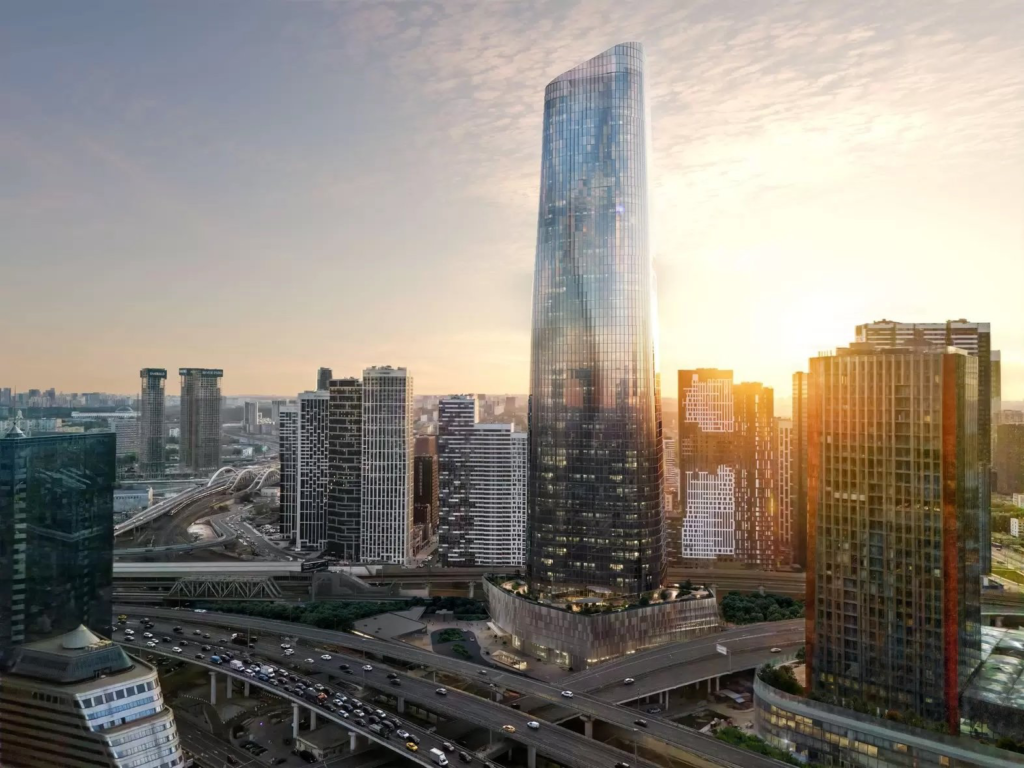
TOP TOWER is set to become Moscow-City’s next architectural landmark – a nearly 300m business skyscraper rising within the Moscow-City International Business Center. Designed for MR Group, this modern complex will encompass 156,000sqm of total space, including 96,700sqm of flexible office layouts and direct underground pedestrian connections to neighbouring towers.
The tower’s office floorplates span up to 2000sqm and include multi-level configurations, while a five-level parking garage accommodates 456 vehicles. 26 high-speed, remotely accessible elevators provide efficient vertical transport throughout the building. Advanced engineering systems feature independent climate control, air humidification and disinfection and high-efficiency ventilation with heat recovery.
Among the tower’s most distinctive amenities is a 5000sqm green roof park on the sixth floor, complete with sports areas, a covered amphitheatre, an all-weather space, and a signature art fountain. The complex also includes 2600sqm of retail and dining space –shops, cafes, and two restaurants with panoramic terraces – all woven into a landscape design that emphasises public spaces, eco-friendly technologies and integrated urban infrastructure.
Architecturally, TOP TOWER presents a tapered silhouette that flows from base to peak, clad in energy-efficient panoramic glazing and illuminated by dynamic facade lighting. According to Sergey Kuznetsov, Chief Architect of Moscow, the skyscraper will stand out thanks to its smooth, bionic form—devoid of angles and sharp lines—composed of numerous glass facets. The tower’s southeast side features modular stained-glass structures measuring approximately 2.15 x 4.2m, forming a wavy curve, while the northwest facade remains flat. This streamlined shell not only creates visual drama but also provides resistance to wind loads, ensuring structural resilience within the dense urban skyline.
