



The UK facade sector is navigating a period of profound transition. A decade on from the Grenfell Tower fire, the industry is navigating a radically-reshaped regulatory environment, increasing demand for housing delivery, and mounting pressure to improve productivity, sustainability and safety.
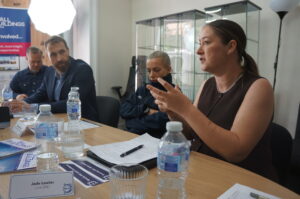
Against this backdrop, a recent Tall Buildings Magazine roundtable brought together leading voices from across the facade value chain – spanning design, manufacturing, installation, regulation and commercial delivery – to explore the evolving role of Glass Reinforced Concrete (GRC) in the UK market.
The discussion revealed a sector full of potential. At its core, the conversation centred on a simple question: how can GRC transition from a niche material into a mainstream solution for high-rise facades?
A market defined by regulation and risk
The post-Grenfell landscape has fundamentally altered how facade systems are specified and delivered in the UK. Increased scrutiny, tighter regulations and heightened liability have created both barriers and opportunities.
On one hand, the market is more cautious than ever. Specifiers, contractors, insurers and clients are reluctant to adopt materials they do not fully understand – particularly in high-rise applications where risk exposure is significant. On the other, this same environment has created a strong demand for non-combustible, performance-proven materials.
GRC sits directly within this opportunity space. However, as highlighted in the roundtable, the challenge is not technical capability – it is confidence. The industry must move towards compliance-led, evidence-backed communication that reassures stakeholders that GRC is not an emerging innovation, but a mature, standards-based solution with decades of proven performance.
 The UK paradox: A pioneer market that fell behind
Interestingly, the UK was once the global leader in GRC – effectively the “cradle” of the technology. Yet early failures in the 1970s and 1980s significantly damaged confidence, creating a legacy that still influences perception today.
In contrast, European markets have moved forward with more consistent application, underpinned by:
- Established Eurocode-based design processes
- Greater trust in supplier-led design responsibility
- Simpler project structures with clearer accountability
The result is a more mature and stable GRC ecosystem across Europe, with fewer reported site issues and greater acceptance.
In the UK, however, fragmentation remains a defining feature. Complex consultant structures, overlapping responsibilities and heightened liability requirements have created a more resource-intensive and risk-averse environment.
Barriers to adoption: Knowledge, trust and capacity
Three primary barriers emerged from the discussion:
Knowledge gaps and fragmentation
While expertise exists within the GRC sector, it is often siloed. Architects, contractors and clients struggle to access clear, digestible information about:
- Design principles
- Cost implications
- Installation requirements
- Performance characteristics
Unlike other facade systems, GRC lacks widely accessible, user-friendly guidance – particularly for non-specialists.
Supply chain trust and capacity
Even experienced users of GRC expressed hesitation due to:
- Limited UK manufacturing capacity
- Reliance on European suppliers
- Perceived instability in supply continuity
This creates uncertainty at specification stage, particularly for large-scale projects requiring long-term delivery confidence.
Commercial and cost uncertainty
GRC is often perceived as expensive, however, comparisons are frequently misleading.
The roundtable emphasised that cost is not well understood in context. Early-stage budgeting often ignores:
- Reduced crane and scaffolding requirements
- Faster installation programmes
- Increased offsite manufacturing efficiency
- Lower long-term maintenance
Without this broader value framing, GRC is often rejected prematurely during value engineering exercises.
Design complexity: The hidden challenge
One of the most critical insights from the discussion was the complexity of facade design coordination in the UK.
Typical facade specifications are only partially defined at early stages – often around 60% complete – with the remaining 40% evolving during design development. This creates significant challenges when integrating GRC systems, which require early consideration of:
- Structural loads and fixings
- Tolerances and sequencing
- Interface with other trades
- Installation methodologies
The result is a highly iterative process, often involving multiple consultants and extended decision-making cycles. In one cited case, a design review process expanded from two weeks to over 12 weeks due to fragmented coordination.
This highlights a fundamental issue: GRC is not inherently complex – but it requires earlier, more integrated design thinking.
Standards, guidance and the role of GRCA
The Glass Reinforced Concrete Association (GRCA) plays a central role in defining production and design standards. However, the roundtable identified several limitations:
- The current Design Guide is widely used but outdated
- Standards development is slow and resource-constrained
- Industry engagement in standards processes has historically been limited
Despite this, there is strong momentum towards updating the GRCA Design Guide, with input from manufacturers and contractors – particularly around installation practices and real-world complexities.
A key recommendation is to adopt a more agile approach, potentially releasing draft sections for industry feedback to accelerate relevance and adoption.
 The evolving role of the architect
Industrialised construction is reshaping not only materials, but also professional roles.
The traditional model of the architect as sole design author is giving way to a more collaborative, systems-based approach. In this context, architects are increasingly required to act as systems integrators, coordinators of multidisciplinary inputs and design leads within manufacturing-aware workflows
This shift is particularly relevant for GRC, where design decisions must consider production, transport and installation from the earliest stages.
The value proposition: Beyond cost
Despite the challenges, the benefits of GRC for tall buildings are compelling:
- Lightweight construction, reducing structural loads
- High durability, with minimal maintenance requirements
- Design flexibility, enabling complex geometries and finishes
- Acoustic stability, with no movement or vibration issues
- Non-combustibility, aligning with regulatory requirements
- Offsite manufacturing, improving quality and programme certainty
Crucially, GRC enables both:
- Iconic, high-design facades with complex geometries
- Modular, repeatable systems for efficient large-scale delivery
This dual capability is not well understood in the market and represents a significant opportunity for repositioning the material.
Education and communication: The critical gap
Perhaps the most consistent theme throughout the roundtable discussion was the need for better communication. Current technical guidance is often difficult to access, poorly indexed and/or written for specialists rather than general users.
The roundtable highlighted the success of other sectors in developing:
- Open-access technical notes
- Bite-sized guidance documents
- Clear summaries of regulatory requirements
For GRC, there is a clear need to develop audience-specific resources for designers, procurement teams and site and installation professionals.
Insurance, liability and competence
Under the Building Safety Act, the concept of competence has become central to project delivery. Manufacturers contributing to design may now be considered ‘designers’ – increasing their liability. This reinforces the importance of clearly defined roles and responsibilities, evidence-based decision making and verified technical claims.
Insurers and warranty providers also play a significant role, often influencing material selection and design approaches.
Aligning these stakeholders through shared evidence and standardised documentation is essential for wider GRC adoption.
Manufacturing, capacity and unitisation
The discussion also highlighted structural differences between the UK and European manufacturing landscape.
European facilities benefit from:
- Larger factory footprints
- Greater capacity for unitised systems
- Integration of multiple trades within panelised solutions
In contrast, UK manufacturing capacity is more constrained, limiting the ability to deliver fully integrated facade systems at scale.
For tier-one contractors, the ability to procure unitised panels – combining structure, cladding and glazing – is increasingly attractive, reducing site complexity and programme risk.
Strategic opportunities for growth
The roundtable concluded with a clear set of strategic priorities for unlocking GRC’s potential in the UK facade market:
- Establish a central knowledge platform
A single, open-access resource providing structured, accessible guidance across design, procurement and installation.
- Accelerate standards development
Publish a clear roadmap for updating the GRCA Design Guide, with iterative releases and industry feedback.
- Reframe cost through value
Develop standardised cost-and-logistics templates highlighting programme, efficiency and lifecycle benefits.
- Improve design integration
Appoint lead integrators with decision-making authority to streamline coordination and reduce delays.
- Align stakeholders
Engage insurers, funders and regulators through shared evidence and structured collaboration.
- Develop competency frameworks
Define clear training and certification pathways for designers and installers.
- Strengthen evidence base
Create a repository of case studies, performance data and technical validation.
- Expand installer capacity
Upskill existing facade installers through mentoring and structured training programmes.
- Enhance marketing and case studies
Showcase completed buildings – not construction processes – to demonstrate architectural quality and impact.
- Define sustainability metrics
Provide clear, comparable data on embodied carbon, lifecycle performance and circularity.
 Conclusion: From potential to scale
The UK facade sector is at a turning point. GRC offers a compelling solution to many of the industry’s most pressing challenges – combining performance, flexibility and efficiency in a way few materials can match.
Yet its adoption remains constrained not by capability, but by confidence, coordination and communication.
As the industry moves towards a more industrialised, manufacturing-led future, the opportunity for GRC is clear. The challenge now is to align stakeholders, simplify processes and articulate value in a way the market can understand.
Only then can GRC move from being a specialist solution to a mainstream material for the next generation of tall buildings in the UK.
Event Attendees
Clare Fenton, Principle Facades Manager, Wates
Petr Lederer, CEO, Dako
Simon Hertzum, Consultant, SimonSaysGRC
Ian George, Senior Quantity Surveyor, Bell Building Projects
Gabriela Burlacu, CEO, Accurate Fixing Solutions
David Smith, Senior Media Sales Manager, Tall Buildings Media
Darren Richards, Managing Director, Cogent Consulting
Jade Lawlor, Managing Director, Link GRC

