



Environmental Product Declarations are moving rapidly from sustainability add-on to specification requirement, as developers, planners, investors and project teams demand better carbon data across the tall buildings sector.
Across global cities, the next generation of tall buildings is being shaped not only by architectural ambition and engineering innovation, but by a far less visible metric: embodied carbon.
At the centre of that shift is the growing importance of Environmental Product Declarations, or EPDs – verified datasets that quantify the carbon footprint of construction products. What began as a sustainability reporting tool is now becoming something far more commercially important.
As one participant in a recent Tall Buildings roundtable, hosted in partnership with One Click LCA, put it: “Having an EPD is becoming a ticket to the game. If you don’t have one, you may simply not get specified.”
That was the central message from a discussion that brought together sustainability specialists, engineers, manufacturers and supply chain experts to explore how product-level carbon data is reshaping high-rise design and procurement. The conclusion was clear: EPDs are moving rapidly from optional sustainability credentials to core decision-making data in tall building delivery.

Why tall buildings are under pressure
Tall buildings sit under particular scrutiny in the transition to net-zero construction. Their complex material stacks, heavily serviced floorplates and façade-dominated envelopes mean embodied carbon can represent a significant proportion of their total environmental impact.
That makes high-rise schemes a focus for lifecycle carbon analysis. The roundtable highlighted several reasons why this pressure is intensifying: high embodied carbon intensity, complex multi-material systems, heavy reliance on mechanical and electrical services, façade packages with major carbon contributions and premium investor expectations around ESG performance.
From sustainability badge to specification requirement
Participants said major consultants and developers are increasingly embedding EPD requirements into technical specifications. Tools such as NBS now include EPD filters, meaning products without verified environmental data can become effectively invisible to specifiers.
For manufacturers, the implications are significant. Without an EPD, products may fail to reach the specification stage. As one engineer in the roundtable put it: “Once the EPD is written into the specification, it becomes very difficult for alternative products to come in later if they don’t have the same data.”
That means the presence of an EPD can act as competitive lock-in, helping to protect a specified product from later value-engineering substitutions. Carbon data is no longer sitting at the margins of design. It is increasingly influencing what gets selected and what ultimately gets built.
 A market shaped by clients, investors and planning policy
Regulation was not identified as the primary force behind this shift. Instead, the demand for EPDs is being driven by clients, investors and planning authorities, with regulation developing more slowly in the background.
The drivers discussed included BREEAM v7 requirements for embodied carbon reporting, the emerging UK Net Zero Carbon Building Standard, planning policies in cities such as London, investor ESG reporting frameworks and whole-life carbon assessment requirements.
London was identified as being ahead of the curve. Tall buildings referable to the Mayor are increasingly required to undergo whole-life carbon assessments, and those assessments depend on access to verified product carbon data. Other cities are expected to follow. As one sustainability consultant noted: “London is ahead at the moment, but Manchester and Birmingham will catch up quickly.”
Local planning policy is also becoming more ambitious. Westminster’s retrofit-first approach, for example, requires whole-life carbon assessment for many building types. Taken together, these changes point to a market in which verified carbon data is becoming embedded in approval, planning and funding around major developments.
The economics of low-carbon delivery
The roundtable also highlighted the financial dimension of EPD adoption. For many developers and institutional investors, carbon performance is now embedded within Environmental, Social and Governance strategies, and that can directly affect project financing.
In some developments, achieving net-zero certification has already become a prerequisite for securing funding. One example involved a net-zero laboratory building in which lifecycle carbon comparisons between building systems informed the final design decision. A lower-carbon ventilation solution was selected after detailed carbon modelling demonstrated significant savings.
That analysis is becoming more important as low-carbon performance shifts from corporate aspiration to commercial differentiator. Research cited suggested companies are willing to pay higher rents for buildings with stronger sustainability credentials and higher BREEAM ratings.
MEP and the hidden carbon challenge 
While embodied carbon discussions often focus on structure and façade, the roundtable examined a less visible but equally important contributor: building services.
Mechanical, electrical and plumbing systems are among the most complex elements of a tall building and can represent a significant share of embodied carbon. Yet accurate EPDs for building services remain difficult to produce.
Unlike standardised products, many MEP assemblies comprise hundreds or thousands of individual components sourced from global supply chains. As one manufacturer said: “If you look at a plant room, you could have several thousand components from dozens of suppliers.”
That creates a major data challenge. Pipe clips, fittings, brackets and fasteners may all come from suppliers with limited or no carbon information. In those cases, project teams often rely on generic lifecycle assessment datasets as a practical workaround.
The supply chain data gap
Data availability emerged as a major barrier to wider EPD adoption. Tall building components are often sourced through fragmented global supply chains. Smaller component manufacturers may lack the capacity to produce EPDs, particularly when each declaration can cost several thousand pounds.
As one participant put it: “The biggest sticking point is often the smallest components.”
On large assemblies such as prefabricated plant rooms or MEP modules, gathering carbon data from every supplier can be impractical. The result is an uneven landscape in which some products come with robust data while others remain opaque.
Bespoke design and the limits of standard EPDs
Another challenge lies in the way tall buildings are engineered. Many systems are project-specific and customised, which creates tension with traditional EPD models based on standardised product definitions.
Manufacturers developing bespoke structural or MEP solutions may find that real-world carbon performance is difficult to represent accurately in a generic EPD. One participant summed up the issue clearly: “We design systems specifically for each project, optimising the amount of steel used. But an EPD can only give you a flat-line number that doesn’t reflect those savings.”
If project teams are making design optimisations that reduce material use and carbon intensity, the industry needs ways to reflect that more accurately in carbon reporting.
Moving towards system-level carbon thinking
Rather than analysing every individual component in isolation, system-level EPDs assess the carbon performance of an entire assembly. For designers and consultants working on tall buildings, that offers a more practical form of carbon data, particularly where systems are integrated, prefabricated or repeatedly used.
This aligns with a wider shift in lifecycle assessment. Project teams are increasingly recognising that building performance depends on how systems work together rather than on individual products alone. This is especially relevant in tall buildings, where integrated façade systems, offsite construction methods and prefabricated MEP assemblies are becoming more common.
Digital platforms and better integration
The discussion underlined the role of digital lifecycle assessment platforms in making carbon data usable in projects. Tools such as One Click LCA allow design teams to import EPD datasets directly into whole-building carbon assessments and compare the carbon impact of different products and systems.
That has the potential to make lifecycle carbon analysis a routine part of design decision-making rather than a specialist exercise carried out late in the process. But participants were equally clear about the limitation. As one participant noted: “The software can do the calculations, but it still needs the data.”
Collaboration will be critical 
Participants repeatedly returned to the need for greater collaboration across the industry. Trade bodies, engineering institutions and professional organisations can help develop shared carbon datasets and more efficient approaches to EPD generation.
The collaborative options discussed included shared EPD frameworks for common systems, industry-wide carbon databases, standardised templates for EPD generation and joint initiatives between manufacturers and designers. Such approaches could reduce both cost and complexity, especially for smaller firms.
Skills and understanding also emerged as a critical issue. Many contractors and installers still have limited understanding of lifecycle carbon analysis and how to interpret EPDs. As reporting requirements tighten, training and knowledge sharing will become increasingly important.
Adoption is accelerating
Data cited from Eco Platform, the global network of EPD programme operators, showed construction product EPDs increasing from around 20,000 in early 2024 to more than 60,000 within a year. While legislation may move slowly, industry expectations are changing faster.
As one participant observed: “Industry practice is already moving five to ten years ahead of regulation.”
What happens next
Looking ahead, most participants agreed that EPDs are likely to become a mandatory requirement within the next decade. The factors shaping that transition include the UK Net Zero Carbon Building Standard, European regulation such as the Ecodesign for Sustainable Products Regulation, Digital Product Passports, carbon border adjustment mechanisms and increasing planning requirements.
Many experts expect product carbon data to become a requirement across major construction projects by around 2030. If that happens, manufacturers without EPDs may find themselves struggling to compete.
High-rise developments combine some of the most complex systems in the built environment and face intense scrutiny from planners, investors and sustainability assessors. That makes them a testing ground for how embodied carbon data is gathered, assessed and used.
The roundtable’s message was straightforward. Environmental Product Declarations are no longer simply sustainability reports. They are becoming critical infrastructure for low-carbon building delivery. In an increasingly competitive high-rise market, the businesses able to provide reliable carbon data will be the ones best placed to stay in the game.
Top 10 takeaways from the Tall Buildings roundtable
- EPDs are becoming the “ticket to the game”.
Environmental Product Declarations are shifting rapidly from optional sustainability credentials to essential specification requirements. Without verified product carbon data, manufacturers increasingly risk being excluded from major tall building projects.
- Market demand is driving change faster than regulation.
The pressure is coming first from clients, investors, planning authorities and ESG frameworks, with legislation following behind.
- Tall buildings are under intensified carbon scrutiny.
High-rise developments combine complex material stacks, façade-heavy envelopes and heavily serviced spaces, making them a focal point for embodied carbon assessment.
- Carbon data is now influencing specification.
EPDs are being embedded into technical specifications and digital specification tools, making them an increasingly important factor in product selection.
- MEP systems represent a major carbon challenge.
Mechanical and electrical systems can contain thousands of components from multiple suppliers, making accurate carbon reporting far more complex than for standardised products.
- Supply chain data is the biggest barrier.
Fragmented international sourcing, smaller component manufacturers and limited traceability all make accurate lifecycle carbon data difficult to obtain.
- Bespoke systems do not fit neatly into standard EPD models.
Many tall building systems are project-specific and engineered to optimise material use, meaning generic product EPDs do not always reflect real-world savings.
- Digital carbon platforms are becoming essential.
Tools such as One Click LCA are helping project teams integrate product carbon data into building-level modelling and compare alternative systems.
- Industry collaboration will be critical.
Trade bodies, designers, manufacturers and contractors will need to work together on shared datasets, standardised frameworks and better carbon reporting processes.
- Mandatory carbon data could become standard by around 2030.
With the UK Net Zero Carbon Building Standard, European product regulation and tighter planning requirements all emerging, product-level carbon data is expected to become a normal requirement across major projects.
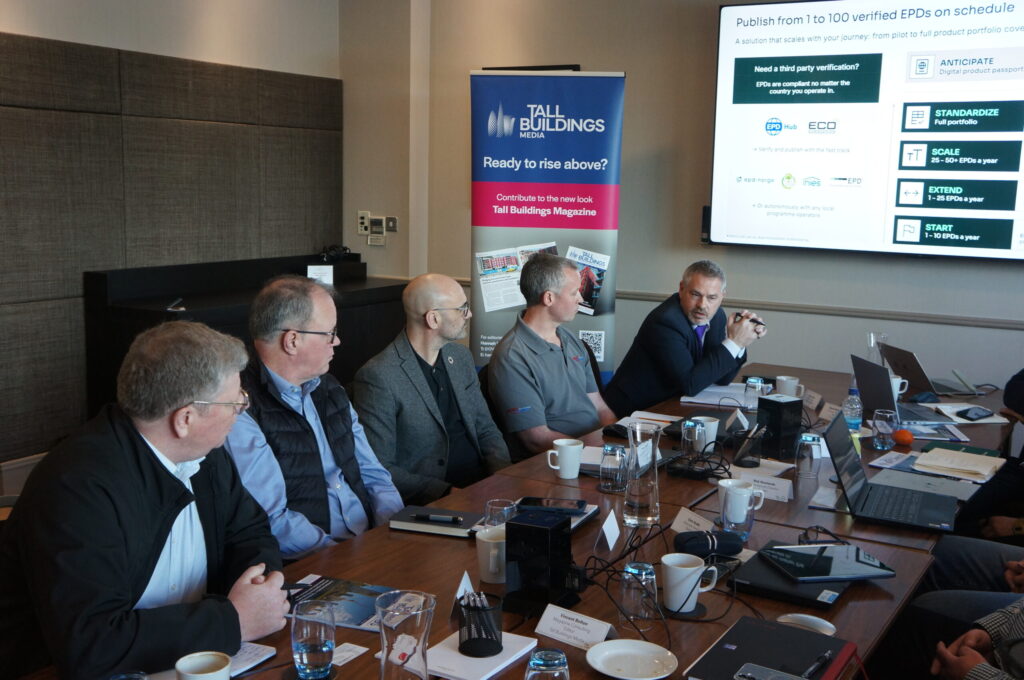
ATTENDEES:

- Facilitator: Darren Richards, Managing Director, Cogent Consulting
- Martin McGrenaghan, Business Development, One Click LCA
- Andrew Cowan, Business Development, One Click LCA
- David Smith, Editorial Team, Tall Buildings Media
- Vincent Bolton, Consultant Editor, Tall Buildings Magazine
- Nastasia Bassil, London Energy & Sustainability Lead, IN2
- Chris Grubb, Associate Director, Ramboll
- Jason Bennett, National Business Development Manager, Zehnder
- David Webster, Technical Sales Engineer, Dutypoint
- Rob Rowlands, Commercial Director, Pipekit
- Jim Gowan, MEP Solutions Manager, Unipart
For more on how One Click LCA is helping the built environment turn carbon data into better decision-making, visit www.oneclicklca.com
If you would like to run a roundtable event, contact David Smith on 01743 290 021 or david.smith@tallbuildingsmedia.co.uk to discuss the opportunities available.
